 Great Smoky Mountains National Park Salamanders
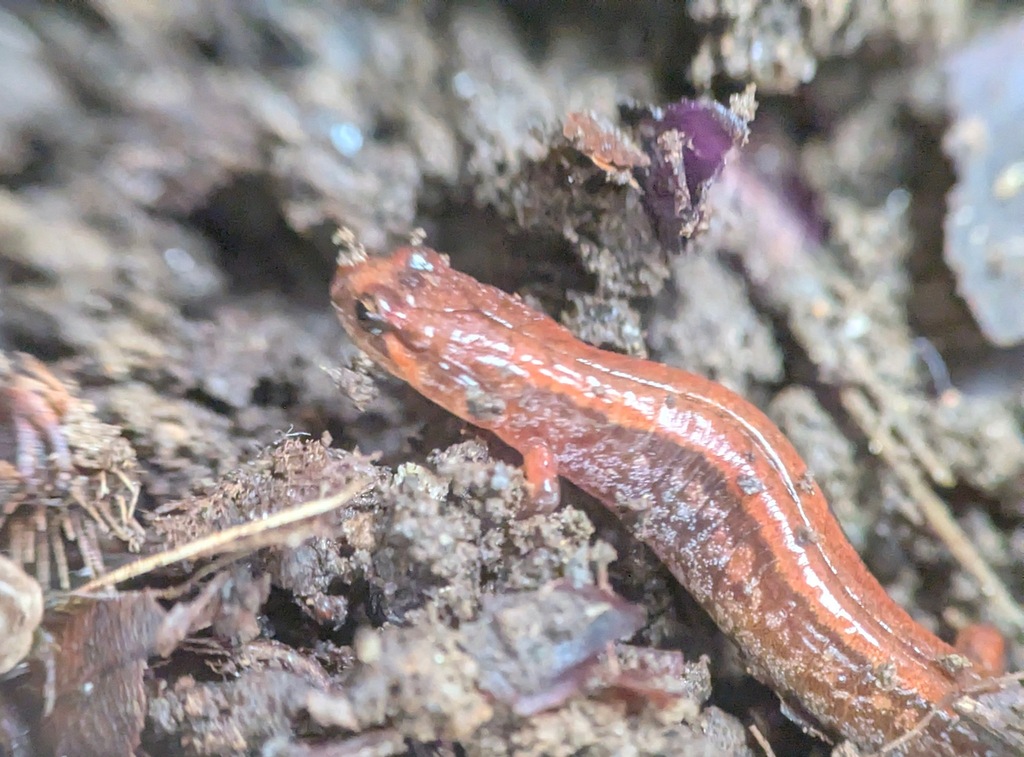
What is this?
Seepage Salamander Desmognathus aeneus
A small, secretive salamander specialized for seepage habitats—wet, mossy slopes and small rivulets. In the Smokies it is patchily distributed in high-elevation seepage bogs and springs, and is often locally abundant where conditions are right.
Very small size, association with saturated moss and thin seeps, blotched dorsal pattern, and quick retreat into moss or narrow water channels help identify this species.
Common Confusions
- Pygmy Salamander Desmognathus wrighti Pygmy is terrestrial and often found in higher elevation bryophyte mats; seepage salamander is tightly tied to narrow water seeps and has different color tones.
- Northern Dusky Salamander Desmognathus fuscus D. fuscus is more stream-edge oriented and usually less restricted to saturated mossy seeps than D. aeneus.
- Slimy Salamander Plethodon glutinosus Slimy is larger and terrestrial; D. aeneus is small and closely associated with seep habitats.
- Four-toed Salamander Hemidactylium scutatum Four-toed has a distinct constricted tail base and white belly with spots; D. aeneus lacks that belly pattern.
- Two-lined Salamander Eurycea wilderae Two-lined salamanders have longitudinal stripes and more elongate bodies; seepage salamander is more blotched and tied to minute water flows.