 Galápagos National Park Endemic Wildlife
What is this?
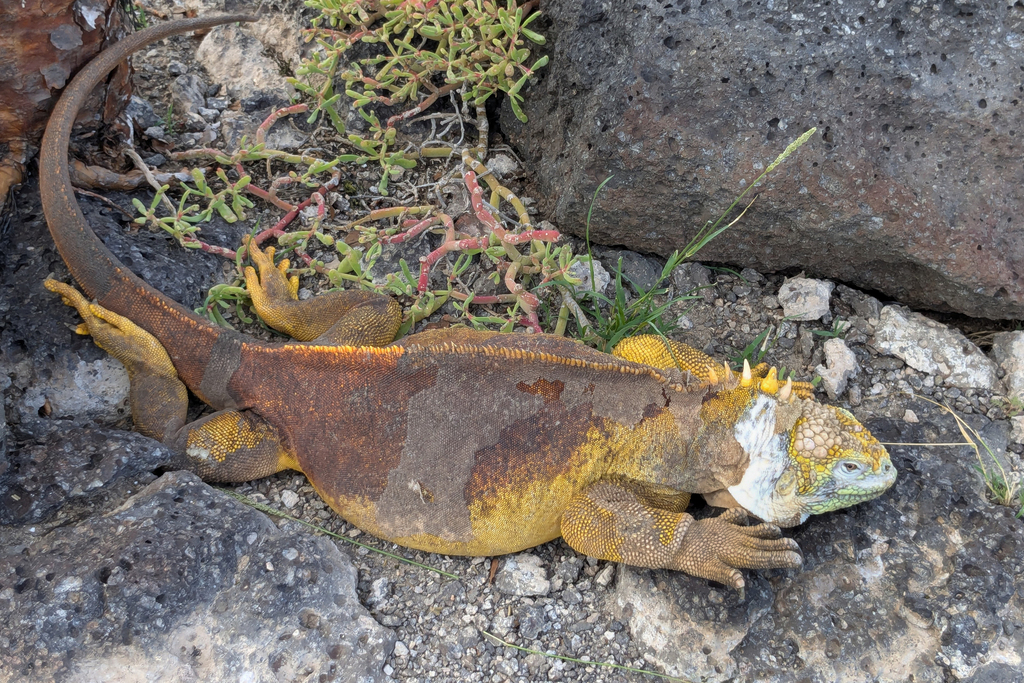
Galápagos Land Iguana Conolophus subcristatus
Terrestrial herbivore that feeds on cactus pads, fruit and low vegetation; typically inhabits arid lowlands and cactus scrub where it burrows or shelters under lava. On islands like Santa Cruz and North Seymour it is a conspicuous, slow-moving component of dry-zone ecosystems.
Yellow to orange-tan body, stout limbs, blunt triangular head, heavy-bodied with granular scales and short spines along the neck; often seen feeding on cactus pads or resting in burrows/shaded lava crevices.
Common Confusions
- Pink Land Iguana Conolophus marthae Pink land iguana (Isabela) is paler with pinkish tones and a different range; Conolophus subcristatus is generally yellower or tan and widespread on dryer islands.
- Marine Iguana Amblyrhynchus cristatus Land iguanas are brightly yellow-orange or tan and terrestrial, while marine iguanas are darker, have flattened tails and forage in the sea.
- Lava Lizard Microlophus albemarlensis Lava lizards are much smaller with slender bodies and faster movements; land iguanas are large, chunky and have a pronounced head shape.
- Young Giant Tortoise Chelonoidis niger Tortoises are quadrupedal with large domed shells and columnar legs; land iguanas are scaled, long-bodied reptiles without a carapace.
- Introduced Monitor Lizards (not typical) Introduced large lizards would have different head shape and behavior; land iguanas have robust herbivore jaws and a characteristic crest.