 Teide National Park Volcanic Plants
What is this?
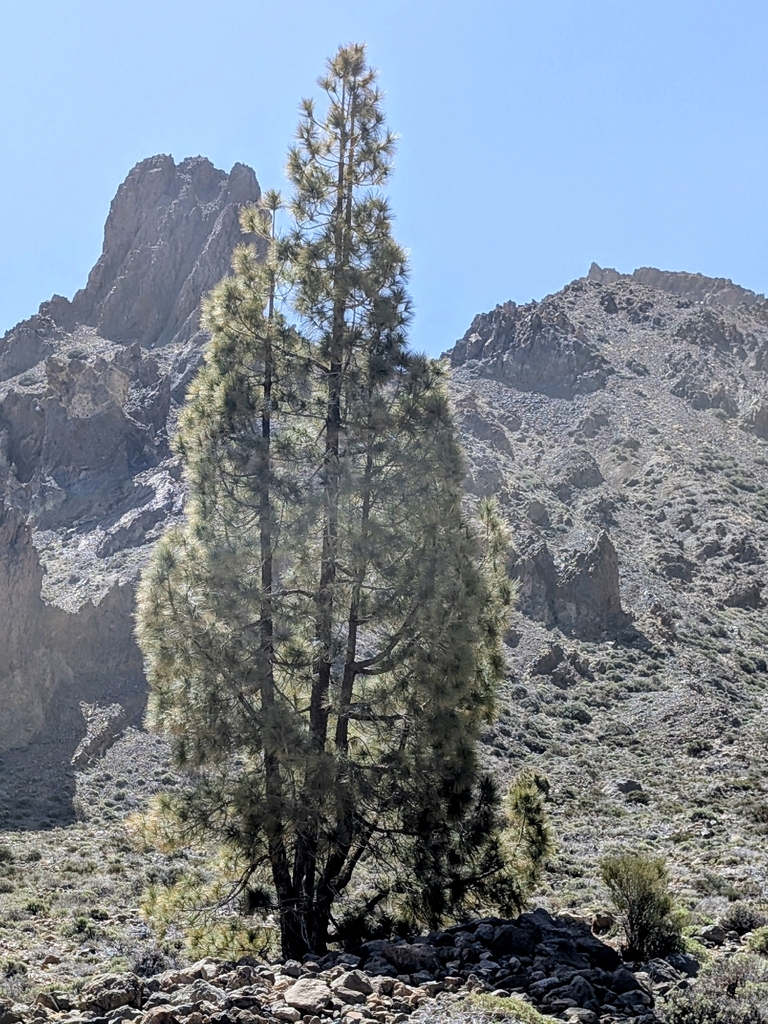
Canary Island Pine Pinus canariensis
A tall, fire-adapted pine endemic to the Canary Islands that forms lower-elevation forests on Teide’s northern slopes and woodlands at ~600–2,000 m. Its long needles and thick bark help it survive volcanic soils and periodic fires, and it shades and enriches soils downslope of the high volcanic plateau.
Look for tufts of very long drooping needles (often in threes), thick, scaly bark that plates with age, and fire-scarred bases where epicormic shoots sprout. Cones are oblong and resinous.
Common Confusions
- Monterey Pine Pinus radiata Pinus radiata has shorter needles in clusters of three and different cone morphology; P. canariensis has long, drooping needles usually in clusters of three and distinctive flared cones.
- Maritime Pine Pinus pinaster P. pinaster has different bark texture and shorter needles; Canary pine’s needles are markedly long (20–40 cm) and often flexible.
- Aleppo Pine Pinus halepensis Aleppo pine is generally smaller with shorter needles and a different crown shape compared with the tall, straight Canary pine.
- Pinus sylvestris Pinus sylvestris Scots pine has shorter, stiffer needles and flaky orange bark in the crown; P. canariensis has long, drooping needles and thick fire-resistant bark.
- Cedrus Cedrus spp. True cedars have very different branching and needle clusters; Canary pine is a true pine with long needles.